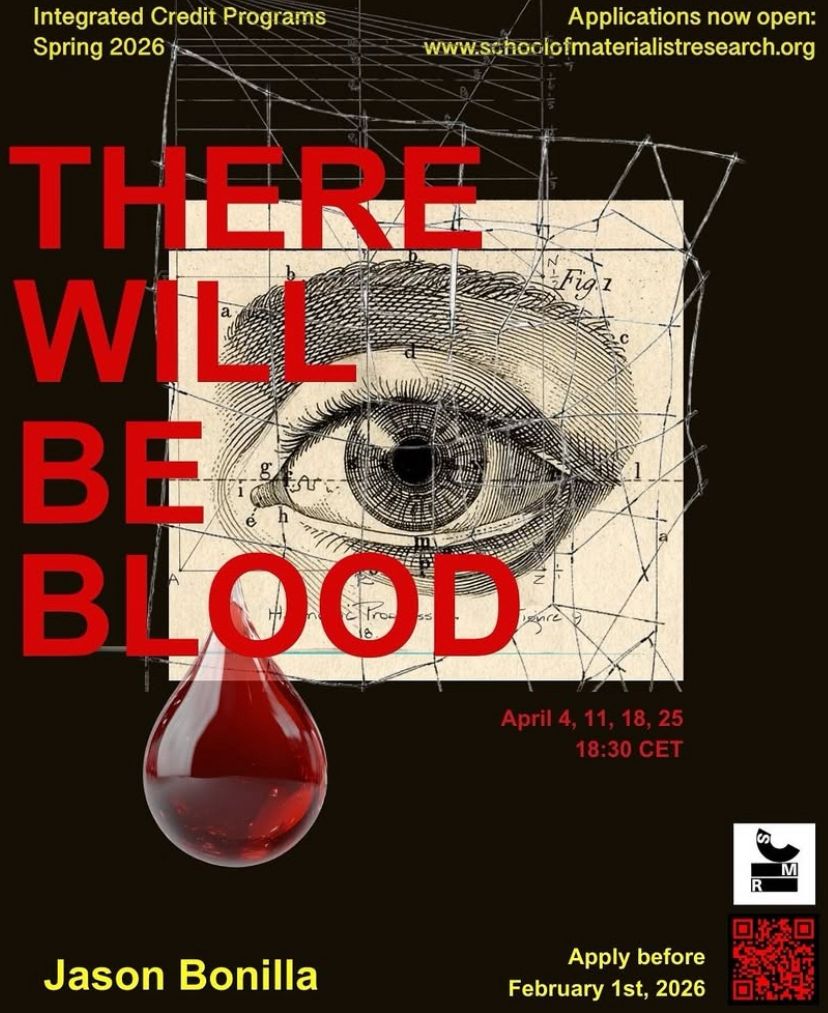
“There Will Be Blood: Factuality, Modality, Normativity”
(April 4, 11, 18, 25 · 18:30 CET · Online)
This course is one of the five courses of the SMR Spring 2026 Integrated Credit Program (ICP). Applications are now open — access the application form via this link.
Description:
Inspired by Huw Price’s 2008 article—or perhaps by Paul Thomas Anderson’s 2007 film of the same name—this course aims to trace a genealogy of the factual, the modal, and the normative. A genealogy of factuality is the project of establishing the objective facticity of existence. A genealogy of modality is the project of understanding how individuals in our factual situation come to rely on modal language (i.e., use terms such as contingency, necessity, possibility, impossibility). A genealogy of normativity is the project of explaining how we use conceptual vocabulary to evaluate ourselves via inferences. Price traces a lineage from David Hume to Robert Brandom, but we would like to broaden the post-Sellarsian spectrum toward neo-rationalism, understood as a rational inhumanism that pursues the autonomy of thought through a Promethean pragmatism. Following Anna Longo in her contribution to the volume The Legacy of Kant in Sellars and Meillassoux, in the post-Kantian problem of synthetic a priori judgments, knowing no longer consists either in deriving particular truths from innate general ideas or in generalizing from isolated sense-data, but rather in understanding objects in accordance with the concepts that pre-structure our experience. To evade both the Scylla of dogmatic rationalism and the Charybdis of skeptical empiricism, Kant restores the terms of the problem by evaluating representations with respect to the laws of our understanding. However, in view of the imminent risk of perpetuating ontological correlationism—when we should retain only epistemological correlationism—we should also inquire into the laws of nature. It is within this horizon that the Hegelian project of a metaphysics of reasons articulates the orientation of a critical speculation in the 21st century.
Syllabus:
Lesson 1. Hume: A Natural History of Philosophy
– Reza Negarestani, Intelligence and Spirit, Appendix: Quandaries of Induction in Philosophy of Knowledge, Philosophy of Mind, and Artificial Intelligence.
– Quentin Meillassoux, “Potentiality and Virtuality,” in The Speculative Turn: Continental Materialism and Realism.
Lesson 2. Kant: German Idealism and its Heritage
– Danielle Macbeth, Realizing Reason: A Narrative of Truth and Knowing, Chapter 1: Where We Begin.
– Daniel Sacilotto, “Puncturing the Circle of Correlation: Rationalism, Materialism, and Dialectics,” in The Legacy of Kant in Sellars and Meillassoux.
Lesson 3. Hegel: Spirit as Normative Realm
– Catherine Malabou, The Future of Hegel: Plasticity, Temporality, and Dialectics, Chapter 12: The Philosopher, The Reader and the Speculative Proposition.
– Paul Ridding, “The Analytic Neo-Hegelianism of John McDowell and Robert Brandom,” in The Blackwell Companion to Hegel.
Lesson 4. Neorationality as Post-Sellarsianism
– Mark Lance, “Placing in a Space of Norms: Neo-Sellarsian Philosophy in the Twenty-First Century”, in The Oxford Handbook of American Philosophy.
– Peter Wolfendale, “The Reformatting of Homo Sapiens,” in Alien Vectors: Accelerationism, Xenofeminism, Inhumanism.
Deadline for Applying: January 31th 2026
“But systematic scepticism is something akin to an explosive chemical chain reaction. Once it is set off, with every passing minute it becomes more difficult to extinguish the flames. Pour on more water, and the fire spreads to areas you never imagined flammable. A genuine philosopher—regardless of their alliances—seeks to examine how the fire spreads. […] Whether it is aligned to materialism or realism, empiricism or rationalism, a philosophy that does not recognize the force of rigorous scepticism or take on its challenges is not worth its name” (Negarestani, 2018, 509-510).
 Anarchopragmatism
Deja un comentario